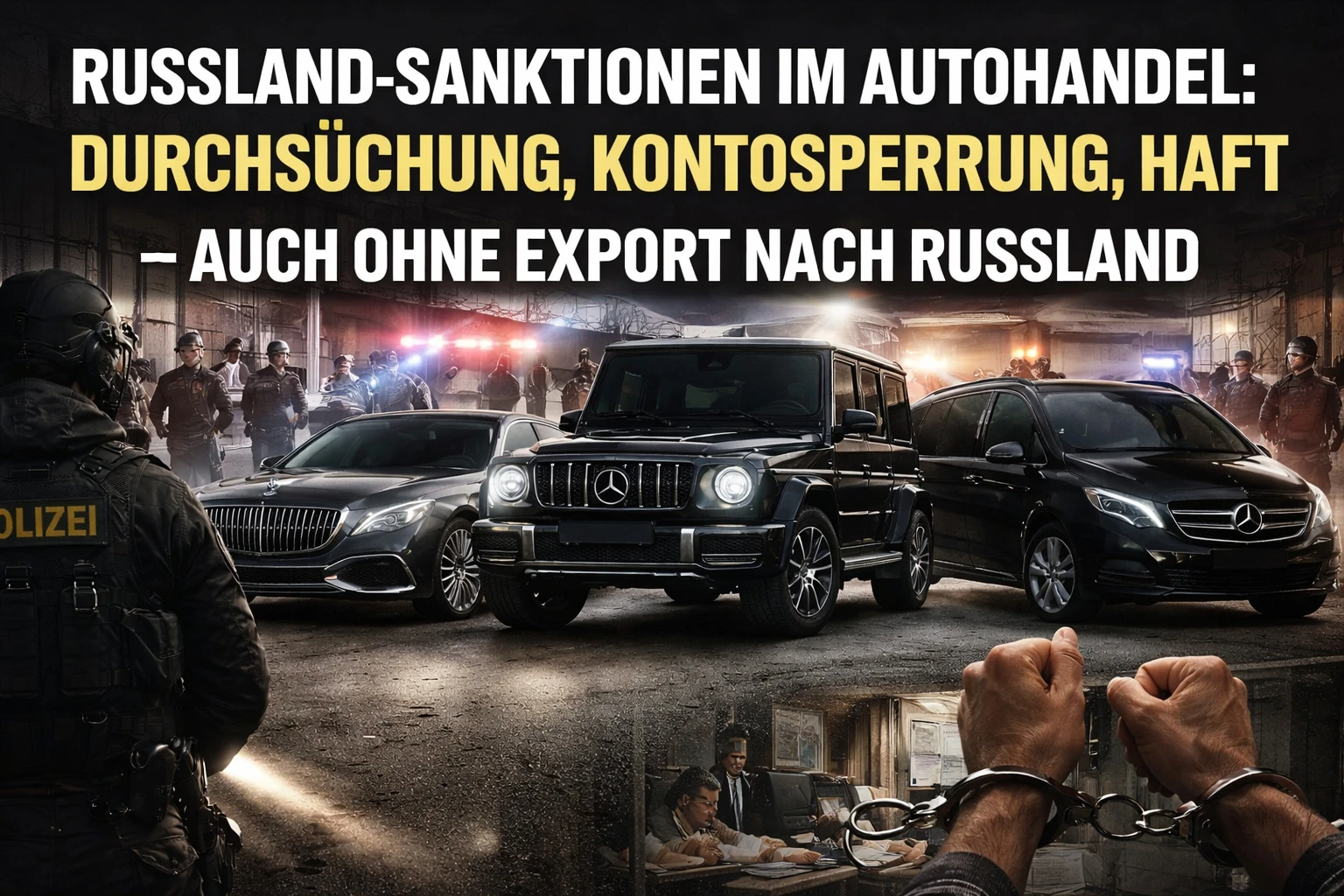
Russia Sanctions in the Car Trade: Searches, Account Freezes, Imprisonment — Even Without Exports to Russia
14405
|
13 Mar 2026
|
KLASSEN
Since 2024, customs investigators have been conducting widespread investigations in the open vehicle trade. Even dealers who have not delivered a single car to Russia are being searched, their accounts frozen, their livelihoods destroyed. The reason: Legal gray-market structures look like sanctions evasion in the investigation files. What you can do now – before investigators stand at your door.
A Tuesday morning in February 2026, shortly after six o’clock. Twenty officers from the customs investigation service stand in front of a car dealership in southern Germany. Search warrant, two patrol cars, a data-seizure team. The managing director – a client of ours – is surprised at the front door in her pajamas. The accusation: commercial sanctions evasion under Section 18(7) of the German Foreign Trade and Payments Act. Penalty range: two to fifteen years of imprisonment.
What she had actually done: purchased vehicles through intermediaries and resold them to buyers with foreign passports. Not a single vehicle had gone to Russia. Not a single buyer was on a sanctions list. But the transaction patterns – intermediary companies, rapid changes of ownership, a buyer with a Kazakh passport – triggered an alert in the customs investigation analysis software. Algorithms know no industry reality. They only know patterns.
This case is not unique. Since 2024, a wave of investigations has been sweeping through the German vehicle trade that no longer affects only actual sanctions violators. It affects the entire open market – an industry whose completely legal business practices look like a textbook on sanctions evasion in the investigative logic of the authorities.
The investigation wave: Why the entire open vehicle trade is under pressure
The scale is unprecedented. The Munich I Public Prosecutor’s Office is currently handling 200 to 300 cases in the area of sanctions evasion involving luxury vehicles alone. The customs investigation offices in Essen, Munich, and Frankfurt have established specialized investigation teams that systematically analyze export data, payment flows, and dealer networks. In March 2026, the Würzburg Regional Court sentenced a dealer to six years of imprisonment and confiscation of nearly 20 million euros. The Marburg Regional Court had already sentenced a car dealer from central Hesse to five years in prison in July 2025. Three dealers from Ortenau have been in pre-trial detention since the end of 2024.
What these cases have in common: those convicted actually delivered vehicles to Russia. But the investigations that led to these judgments were not conducted surgically against individual suspects. They were rolled out like carpet bombing across entire dealer networks. Anyone who appears in the investigation files as a contact person – because they once sold a vehicle to a later suspect, because an intermediary company appears in both supply chains, because a payment stream ran through the same account – becomes a focus of attention. Even if they had absolutely nothing to do with sanctions evasion.
And the current calm is deceptive. The searches of 2024 and 2025 were the first step. Now the authorities are completing their investigations and the public prosecutors are deciding: indictment or dismissal. As older cases are closed, investigative capacities are freed up – for new proceedings. The Financial Intelligence Unit, the European Public Prosecutor’s Office (EPPO), customs authorities, and the EU’s Anti-Money Laundering Authority (AMLA), launched in July 2025, are specifically expanding their capacities. The next wave is not coming. It has already begun.
The gray market: Industry reality meets investigative logic
The non-brand-bound vehicle trade operates according to its own rules. These rules are not illegal. They are the natural consequence of a distribution model that deliberately excludes independent dealers from direct manufacturer supply. If you want to procure a new vehicle as an independent dealer, you have no choice but to purchase through intermediaries, day-registration dealers, or foreign importers. This is not concealment – it is market mechanics.
Yet these very market mechanics create transaction patterns that, from the perspective of an investigator, look like the basic formula of sanctions evasion. A vehicle that changes ownership three times within 48 hours looks like a concealment chain in an investigative file. An intermediary company in the United Arab Emirates acting as a purchasing agent becomes evidence of third-country circumvention. And if the GPS tracker of a leased vehicle is deactivated upon handover – a standard procedure because the new owner does not want to be tracked by the leasing company – this becomes evidence in the investigative report of an intention to conceal the final destination.
In most cases, the customs investigation service does not know this industry reality. The investigators come from the customs administration, not from the automotive trade. They work with analysis software that scans trade flows for statistical anomalies. They see transaction chains and apply patterns they know from embargo investigations. That the same patterns have represented completely legal normality in the open vehicle trade for decades is unknown to anyone in the investigation team. The result is a structural misunderstanding that endangers livelihoods every day.
Five business practices that can make you an investigation target
The first and most common misinterpretation concerns purchasing through intermediary companies. In the open vehicle trade, this is standard. You buy from a re-importer who purchases from an EU importer who buys from an authorized dealer in the country of origin. Three or four steps before the vehicle reaches you. Each of these steps has an economic reason: price arbitrage, margin optimization, access to quotas. For investigators, every additional transaction is evidence of concealing the true business purpose – especially if one of the intermediaries is located in a country known as a transit state for exports to Russia.
The second misinterpretation concerns rapid resales. A vehicle that you purchase in the morning and resell in the evening is not unusual in the gray market. Profit margins in the open trade arise from speed, not storage time. Every day a vehicle stands in the yard costs financing, insurance, and space. For an investigator suspecting sanctions evasion, however, a vehicle that changes ownership within hours is a classic pass-through pattern – the dealer becomes merely a transit station in an alleged supply chain to Russia.
The third misinterpretation concerns the deactivation of GPS and telematics systems. In practice, there are numerous legitimate reasons in the open vehicle trade: a returned leased vehicle is defleeted because the leasing company demands the telematics unit back. The buyer does not want manufacturer telematics because they reject data sharing. The system causes false alarms and malfunctions. In the investigative file, however, GPS deactivation is regularly interpreted as evidence that the dealer intentionally wanted to prevent the actual whereabouts of the vehicle from being traced. The investigative logic is: anyone who switches off tracking has something to hide.
The fourth misinterpretation concerns cash payments and unusual payment routes. In the international gray market, cash payments or payments through third parties are not uncommon – for example because the buyer does not yet have a German bank account, because an intermediary processes the payment, or because the transaction takes place in a currency outside the SEPA area. For the money-laundering department of the customs investigation service, every cash payment above €10,000 and every third-country payment is a warning signal. The bank reports the transaction to the Financial Intelligence Unit. The FIU forwards it to the public prosecutor’s office. And suddenly you are part of an investigation that has nothing to do with your actual business.
The fifth misinterpretation concerns sales to buyers with connections to third countries. You sell a vehicle to a Kazakh national with a German residence permit and a German business registration. A normal transaction. For customs investigators currently tracking transit routes via Kazakhstan, Kyrgyzstan, and Turkey, the buyer’s nationality alone is already an investigative lead. Investigators know that Kazakhstan’s car imports have increased by more than 1,100 percent since 2022. That your specific buyer registered the vehicle in Germany and drives it to work every day appears nowhere in the statistics.
What happens when customs investigators ring your doorbell at six in the morning
Imagine: twenty officers simultaneously enter your business premises and your private home. Your phone is confiscated. Your laptops, your servers, your entire business documentation are packed into boxes and taken away. Your employees stand stunned in the showroom while officers open cabinets and rummage through drawers. Your wife is asked by an officer at the front door to open the basement.
At the same time, something happens that most affected people only realize days later: the public prosecutor applies for asset seizure under Section 111b of the German Code of Criminal Procedure. Your business account is frozen. Your private accounts are blocked. Your vehicles in the yard are sealed as evidence. From one day to the next, you can no longer pay suppliers, transfer salaries, or fulfill ongoing contracts. Your car trade comes to a standstill – and the confiscation of assets under the gross principle of Section 73 of the German Criminal Code affects not only your profit but the entire sales proceeds.
News of the search spreads through the industry within hours. Your business partners distance themselves. Suppliers demand advance payment. Your house bank cancels your credit line. And while you try to hold the pieces together, the investigation continues – using your own documents against you.
All this can also happen to a dealer who has not delivered a single vehicle to Russia. The search warrant is based on an initial suspicion – and such suspicion can arise merely from the accumulation of the transaction patterns described above. The burden of proof effectively reverses: the public prosecutor does not prove your guilt. You prove your innocence – with the documents that have just been taken away from you.
The legal boundary: When does gray-market trading become criminal?
Criminal liability depends on one single question: Did you know – or did you accept the possibility – that the vehicle would end up in Russia? The criminal provision of Section 18 of the German Foreign Trade and Payments Act in conjunction with the export bans of Articles 3a and 3g of Regulation (EU) No. 833/2014 requires intent. Pure negligence is not sufficient for criminal liability under current law – although it may constitute an administrative offense under Section 19 AWG with fines of up to €500,000.
The problem: investigative authorities regularly infer intent from objective circumstances. In its March judgment, the Würzburg Regional Court essentially justified conditional intent by stating that the defendant knew the export bans, purchased through shell companies, and took systematic measures to conceal delivery routes. This reasoning pattern can – and this is precisely the risk – be applied to any independent dealer whose transactions show similar objective characteristics. The difference lies solely in the internal fact of knowledge. And courts prove internal facts through external indicators.
The more of the described industry practices coincide in a particular transaction – intermediary companies, rapid resales, cash payments, buyers with third-country connections – the more the indicators accumulate into proof of intent. A single feature is not enough. Three or four together are usually sufficient for the public prosecutor to file charges.
Added to this is the anti-circumvention clause of Article 12 of Regulation (EU) No. 833/2014. It explicitly covers participation in activities whose purpose or effect is to circumvent the sanctions prohibitions. The wording is deliberately broad. It allows law enforcement authorities to pursue transactions where the dealer themselves had no direct contact with the Russian end buyer – as long as the objective effect of the transaction was delivery to Russia. Attribution works through the chain: you delivered, an intermediary passed it on, the goods ended up in Russia. That you neither planned nor intended this is your defense line – but you bear the burden of presenting the argument.
For your defense in white-collar criminal law, this means: the mistake of prohibition under Section 17 of the German Criminal Code and the mistake of fact under Section 16 of the German Criminal Code are the central defense strategies. Anyone who can prove that they did not know the sanctions prohibitions or misjudged their scope can avoid criminal liability. However, case law sets high requirements for the inevitability of such a mistake. In the case of a professional dealer who trades vehicles worth more than €50,000 on a daily basis, a court will consider ignorance of the Russia sanctions unavoidable only in very limited exceptional cases.
The AWG amendment: Why the pressure will increase further
The planned amendment to the Foreign Trade and Payments Act will further significantly tighten the situation for the open vehicle trade. The legislator plans to introduce a criminal offense based on recklessness. Until now, only intentional conduct under Section 18 AWG was punishable. In the future, criminal prosecution will also be possible for those who recklessly violate embargo regulations – that is, act with gross negligence.
For gray-market dealers, this has concrete consequences. Anyone who does not conduct an end-use check, who relies on the buyer’s verbal assurance that the vehicle is intended for the German market, who does not ask questions and does not document the case when dealing with a buyer with Kazakh nationality – may be acting recklessly under the new legal framework. And recklessness will be sufficient for a conviction.
In addition, there is a tightening of the fine framework. The draft provides for fines of up to €40 million or ten times the transaction value – whichever amount is higher. This scale shows that the legislator does not consider the vehicle trade a minor sector. The asset confiscations worth millions that courts already order today are merely a preview of what is likely to become standard under the amendment.
What you should do now – before investigators arrive
The first and most important step: ensure accessibility for emergencies. When customs investigators stand at your door at six in the morning, every minute counts. At that moment you need a specialized white-collar criminal defense lawyer who answers the phone immediately, who understands the specifics of the vehicle trade, who tells you on the phone what you should do and what you should not do. Our emergency hotline is available around the clock, including weekends and holidays. Save the number now. Not tomorrow. Now.
The second step: conduct an honest assessment. Check whether vehicles you sold in the past three years may have reached Russia via third countries. Check whether there were buyers whose identity or business purpose raises questions in retrospect. Check whether your documentation is fully traceable – or whether an investigator might find the same suspicious patterns described above in your records. What you discover should be discussed with your lawyer. Not with your business partner, not with your tax advisor, not over the phone. With your lawyer. Under the protection of attorney-client privilege.
The third step concerns your business processes. Document every sale in such a way that an outsider – meaning an investigator – can immediately understand why the transaction occurred the way it did. If you purchase a vehicle through an intermediary company, document the economic reason. If you sell to a buyer with connections to a third country, document the end-use check – even if the result is negative. The documented rejection of suspicious inquiries is particularly valuable in an investigation. If you deactivate GPS, document the reason. What is not documented does not exist in an investigation.
And the fourth step: prepare your employees. Everyone in your company must know what to do during a search. No statements to officers. Sign nothing. Do not hand over passwords. Photograph the search warrant. Formally object to the search. And call the lawyer immediately. Anyone who destroys documents in panic, deletes phones, or makes careless statements to officers turns a manageable investigation into a catastrophe.